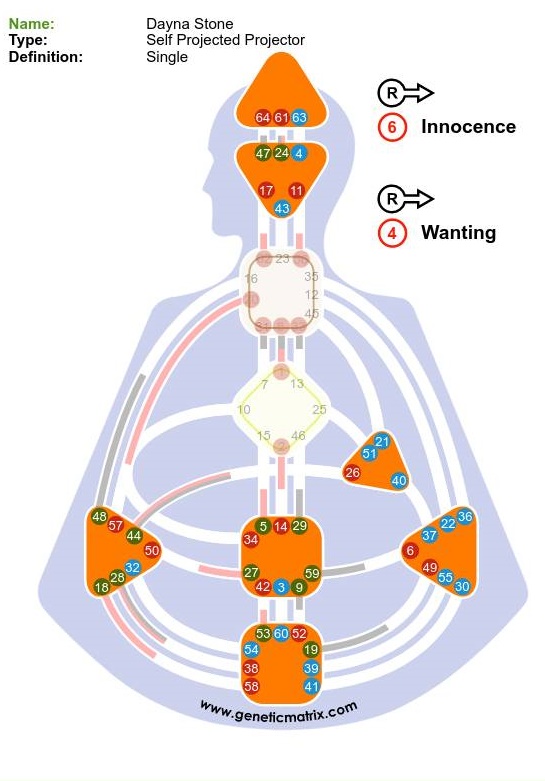
I’m more than half-way through the Rave ABC course now and finding much of it repetitive, but this is only because I’ve done so much self-study. 🙂 The topic of the last two weeks has been circuit groups. I’m going to present my notes and findings here in two parts, not only for myself but for those doing their own HD study. 😉 Part 1 is the data, part 2 will be my application of the data to my charts and my husband’s chart (the fun part IMO).

Circuitry = How we connect and interact with others in life. A circuit is composed of channels (the lines connecting the numbers (gates) in the above example). There are a total of 36 channels.
There are three circuit groups in HD : Individual, Collective, and Tribal.
Individual Circuitry – The middle track of the bodygraph. It has the most gates and channels of all the groups plus encompasses the four awareness centers and all the motors.
Keywords: Empowerment, Individuality.
Format: Pulse, mutation
Time: Now
Sense: Auditory (hearing)
Emotional Wave: Spike up/down
Collective Circuitry – The outside track on the bodygraph. It is only about sharing, nothing else. There is no reliability here. No promises kept.
Keywords: Sharing, make sense of the past, Project to the future.
Format: Cyclic and focused
Time: Past/Future
Sense: Visual
Emotional Wave – Crash wave; rise/fall
Tribal Circuitry – The inside track on the bodygraph. About gathering resources, supporting life/survival, the “team”, games, bargaining, give and take. The Tribal Circuit is “sticky”, meaning it can’t help but stick to others like glue.
Keywords: Support
Format: None
Time: None (timeless)
Sense: Tactile (touch and smell)
Emotional Wave: Ratchet wave
Integration Channel
It is the one channel that is different than all the other channels in that it operates through four gates instead of two. People with this channel are the most self-absorbed, selfish/self-interested. This channel has the ability of the body’s immune system to guide us to safety in the Now (Splenic Center driven). This channel is NOT mutative. It only has mutative qualities when connected to the 28 and/or 38th gate or both.
Keywords: Safety in the Now, Lone Wolf
Note: The gates of the channels in the above centers and circuitry will impact a person if present in their body graph in that they create consistency in how the person navigates through life. Those gates/channels not present will be where conditioning is present and where the mind tends to focus (the mind always focuses on what we are not).
The assignment from class #4 was to create a chart of all the white spaces in our body graph in order to see all the not-self possibilities that exist for us. This is my result (sorry the scan is crooked and I’m too lazy to rescan):
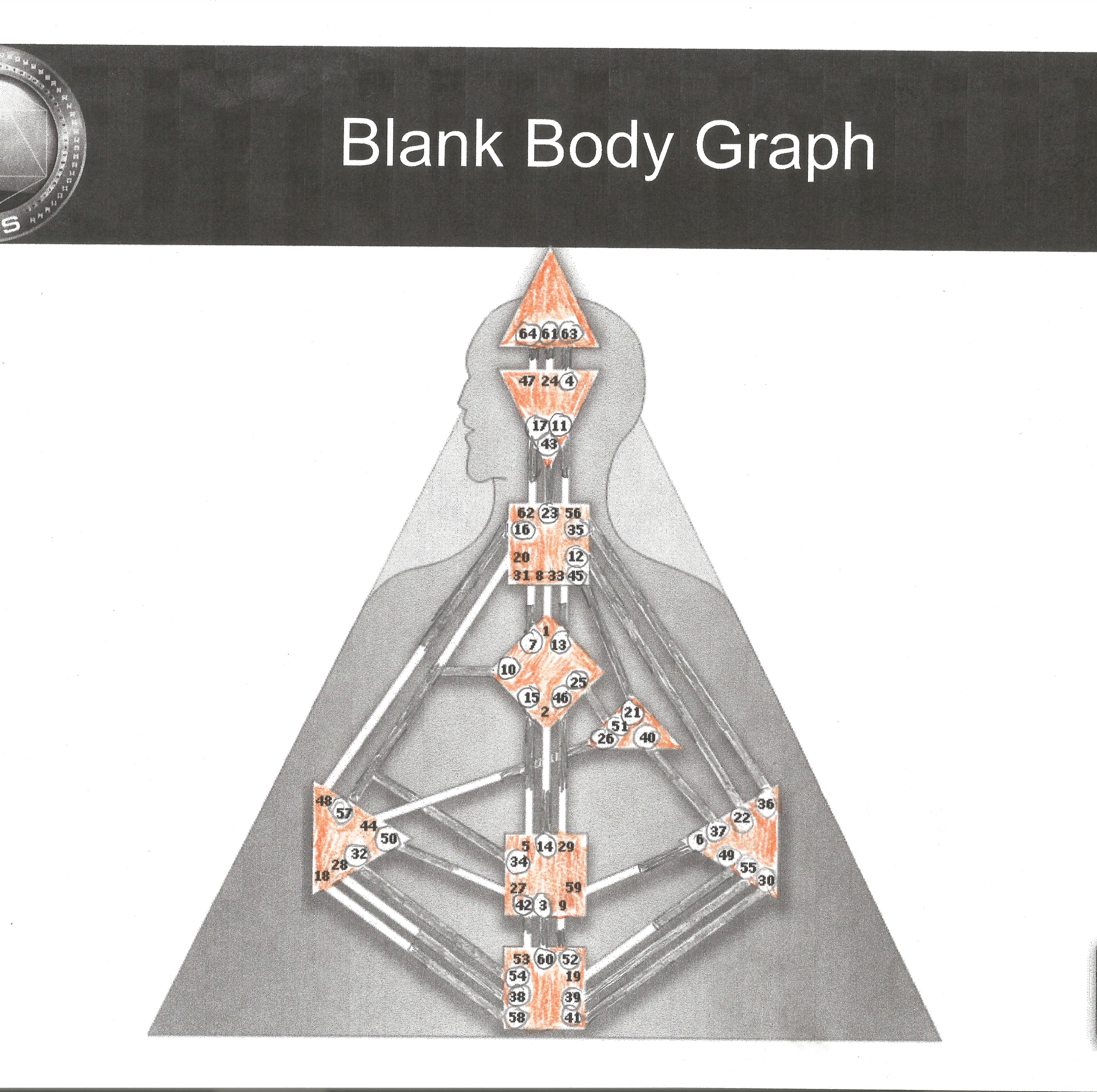
My reaction to seeing how much conditioning is possible in my design was that it was expected. I already feel like I am more like a Reflector than a Projector because I only have one channel (1-8) and it is half conscious and half unconscious (black/red respectively). This means that when my chart is split into unconscious and conscious sections I am a Reflector in both charts. Seeing all the white spaces colored in was somewhat depressing. I think I cried, actually. I can’t believe I did this to myself in this life!
Featured Image: Shadow Chart from Genetic Matrix. Highlights my undefined centers.
References:
Bunnell, Lynda and Ra Uru Hu. (2011). The definitive book of human design. Carlsbad, CA. HDC Publishing.
Blanding, Theresa. (2011). Rave abc’s Student manual. Santa Fe, NM. Human Design America.
 Living Life in Between
Interesting Dayna.From my perspective there’s a gift inherent in every personality signature we’ve chosen. Look deeper to find the gift.
LikeLiked by 1 person
Thanks, Eric. I’m trying.
LikeLike